
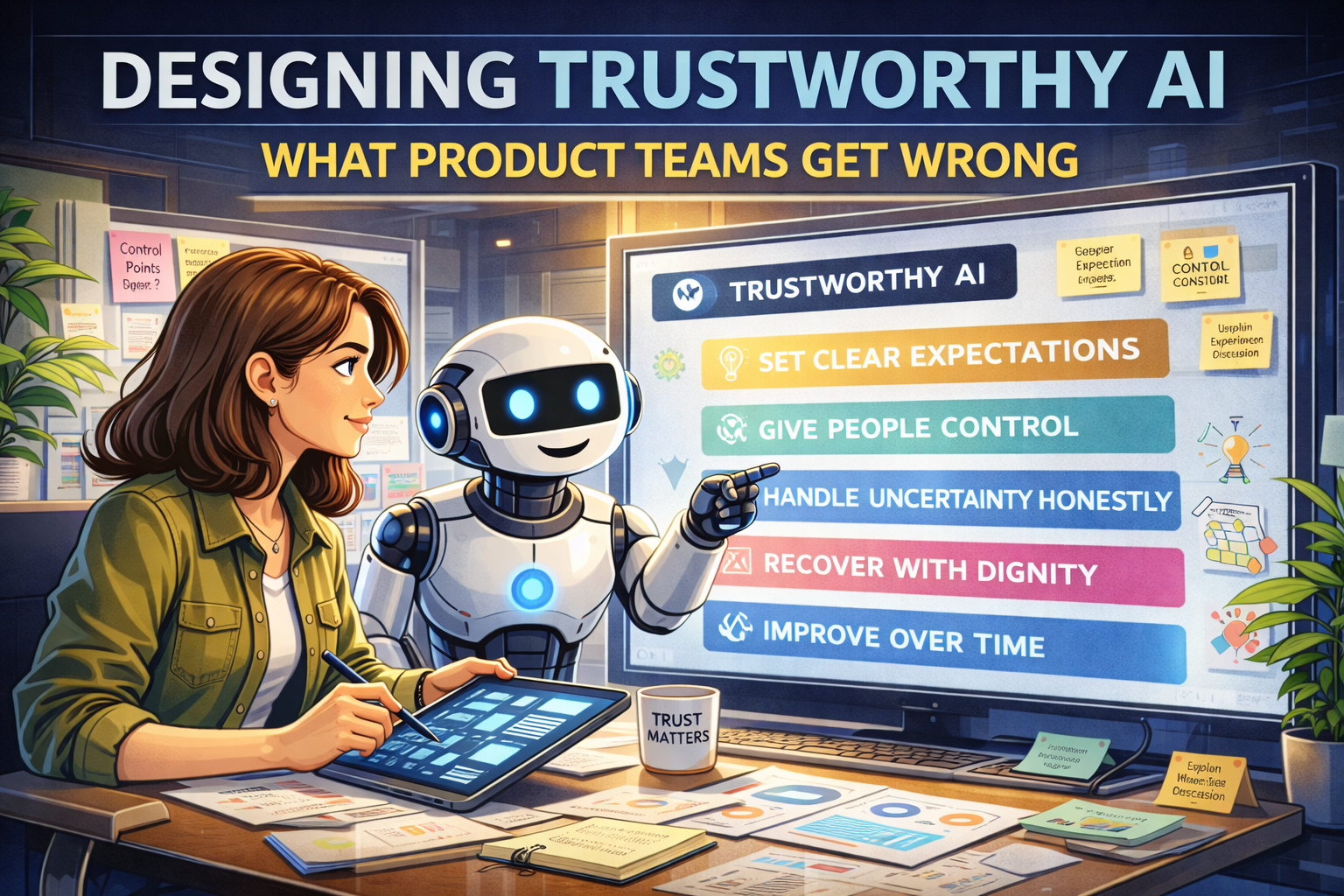
Designing Trustworthy AI: What Product Teams Get Wrong
Trustworthy AI Is a Product Decision
A lot of teams say they care about trustworthy AI. Far fewer build it that way.
Usually, what happens is this: a team gets excited about a new AI capability. The demo looks impressive. The internal energy is high. People start talking about smarter workflows, automation, personalization, and transformation because apparently no strategy meeting is complete without at least one dramatic noun.
Then the product launches. And users start asking very normal questions:
- Can I trust this?
- Why did it do that?
- Is this using my data?
- Why does it sound so confident when it is wrong?
- How much control do I still have here?
That is the moment when a lot of teams realize they treated trust like messaging instead of product design. That is the mistake.
Trustworthy AI is not something you sprinkle on top after the model works. It is not a landing page section. It is not a legal paragraph nobody reads. It is not your CEO saying “we take this seriously” on a podcast.
It is a product decision. Actually, it is a series of product decisions. And if those decisions are weak, users will feel it fast.
The Short Version
Trustworthy AI comes from building products that are clear, controllable, reliable enough for the job, and honest about what the system can and cannot do.
What teams usually optimize for
- How powerful is the model?
- How much can it generate?
- How many use cases can we ship?
What they ask less often — but should
- Will people understand what the system is doing?
- Will they know when to trust it — and when not to?
- Can they recover easily when it is wrong?
- Does the product earn confidence over time?
Trust Is Not a Brand Layer. It Is a Product Behavior
This is the first thing worth getting straight. Trust is not mostly about what you say. It is mostly about what the product does and how it feels when people use it.
A user does not decide whether your AI is trustworthy because your site says “built responsibly.” They decide based on moments like these:
- Did the product help me when I needed it?
- Did it fail in a way I could understand?
- Did it pretend to know something it clearly did not?
- Did it give me enough control?
- Did it respect the context I was in?
- Did it make me feel informed or slightly uneasy?
That is why trust in AI is so product specific.
The product experience teaches people what to believe. Not your tagline.
“The product experience teaches people what to believe.”
Not your tagline.
What Trustworthy AI Actually Means
A trustworthy AI product usually does five things well.
1. It sets the right expectations
The product makes it clear what the AI is there to do, what kind of output to expect, and where its limits are. It does not quietly imply human-level judgment when it is really offering best-effort assistance. It does not act like confidence and competence are the same thing. And it does not leave users guessing whether they should treat the output as a draft, a suggestion, a prediction, or a decision. Clear expectations reduce confusion before confusion turns into disappointment.
2. It gives people appropriate control
Users do not always need full manual control over every AI behavior. But they do need the right kind of control for the context. That might mean being able to review before sending, edit or reject the output, turn a feature off, correct the system easily, or understand why something happened. Trust usually goes up when users feel the AI is helping them, not trapping them inside its choices.
3. It handles uncertainty honestly
AI systems are not always certain. But many products behave as if uncertainty is an ugly secret that must be hidden from users at all costs. That usually backfires. Users do not need the product to feel weak. They do need it to feel honest. Sometimes trustworthy design means saying: “I’m not fully sure.” “This is a draft.” “You may want to verify this.” “I need more context.” That kind of honesty often builds more trust than fake confidence ever will.
4. It recovers well when things go wrong
Every AI product will be wrong sometimes. The question is not whether failure happens. The question is what failure feels like. Does the product make it easy to fix? Does it explain enough to keep the user oriented? Does it preserve dignity when the output is awkward or wrong? Does it help the user move forward? Trust is not built by perfect performance. It is often built by good recovery.
5. It gets more understandable over time
The best AI products teach users how to work with them. They become easier to predict, easier to guide, and easier to trust because the product creates a clearer mental model over time. Users learn what the system is good at, where it needs help, and how to get better results. Ideally, the product helps that learning happen without requiring a PhD or a support ticket. That is part of trustworthy design too.
What Product Teams Commonly Get Wrong
Now let’s talk about the traps. Because most trust failures are not random. They follow patterns.
Mistake 1: Treating trust like a compliance box
A team says they care about responsible AI, so they add a policy page, a few safety statements, and some vague copy about ethics. Then everyone moves on. Compliance matters. Privacy matters. Legal review matters. But users do not experience compliance documents. They experience product behavior. If the AI is confusing, overconfident, intrusive, hard to correct, or inconsistent in high-stakes moments, the product will still feel untrustworthy. Trust lives in the interaction, not just the paperwork.
Mistake 2: Overpromising what the AI can do
Some teams want the product to sound magical, so they describe it in ways that are broader, smarter, and more definitive than the actual experience deserves. Then users try it — and the gap between promise and reality does the damage. This is especially risky in AI because the outputs can sound polished even when they are wrong. A good product team understands this. They aim for confidence without fantasy.
Mistake 3: Designing only for the happy path
A lot of teams spend most of their energy on the ideal flow: the AI gives a strong answer, the user likes it, the workflow feels smooth, and everyone feels smart. But real trust is usually decided in the non-ideal moments. What happens when the answer is incomplete? When the system misunderstood the request? When the output sounds confident but should not be trusted yet? When the AI takes too long? When the user wants to undo, retry, or correct the result? If you do not design those moments well, the product may look good in a demo and feel stressful in real life.
Mistake 4: Confusing transparency with overload
Some teams respond to trust concerns by exposing everything: long explanations, huge disclaimers, technical detail nobody asked for, enough caveats to make the product sound like it was written by a very nervous committee. That is not always helpful. Trustworthy design is not about dumping information on people. It is about making the right information visible at the right moment in the right language. The user usually does not need the full system architecture. They need to know what the product is doing, what it needs from them, and what kind of confidence they should have in the result.
Mistake 5: Ignoring the emotional side of trust
Trust is not only rational. It is emotional. People notice when a product feels evasive, when it acts too confident, when it takes action without enough clarity, or when something private feels exposed. In AI products, emotion matters because people are often navigating uncertainty already. A trustworthy product does not just function well. It feels respectful. It feels legible. It feels like it is working with the user, not around them.
Mistake 6: Measuring usage instead of confidence
A team launches an AI feature. People click it. Usage is decent. Internal dashboards look encouraging. Then support tickets pile up. People retry the same prompt four times. Users edit the output heavily. Trust quietly drops. Adoption flattens. That is why usage alone is not enough. If you care about trustworthy AI, you need to measure signs of confidence and friction too.
Signals of confidence and friction worth tracking
- Acceptance rate
- Edit rate
- Retry rate
- Abandonment
- Override behavior
- Support volume
- Complaint patterns
- Qualitative trust feedback
- Repeat usage over time
What Trustworthy AI Looks Like in Practice
So what should product teams actually do? Here is the practical version.
Start with the user’s risk, not just the product’s capability
Ask: What is the cost of being wrong here? How noticeable is failure? How much context does the user have? How much confidence should they place in the result? How much control do they need? A summarization feature for internal notes and a medical decision support tool are obviously not the same thing. But even lower-stakes products still need trust design. The level of control, explanation, and caution should match the real user risk.
Design the mental model, not just the output
Users need to understand what this AI is for. Is it assisting, advising, drafting, predicting, automating, checking, or summarizing? That mental model shapes trust. If users think the system is making decisions when it is really making suggestions, you get bad outcomes. If they think it is more reliable than it is, you create hidden risk. If they think it is less capable than it is, adoption suffers.
Build clear feedback and correction loops
People trust systems more when they can influence them. That means making it easy to correct a result, give feedback, retry with more context, undo a poor action, see what changed, and improve future output through interaction. Control does not always mean more buttons. It means users can stay oriented and recover without friction.
Be specific in your language
Trustworthy AI products use precise language — not dramatic language, not inflated language, and not fog-machine language. Instead of saying “Your intelligent assistant handles everything for you,” say something more grounded like “Drafts a summary based on your notes,” “Suggests the next step based on previous actions,” or “Flags patterns that may need review.” Better expectations create better trust.
Treat post-launch signal as part of the trust system
Trust is not designed once. It is maintained. You need to listen for where users hesitate, where they over-rely, where they get confused, where support spikes, where feedback clusters, and where the product is technically correct but experientially off. That signal should shape roadmap decisions, UX updates, onboarding, and messaging. Trustworthy AI is not just what you launch. It is how you keep learning.
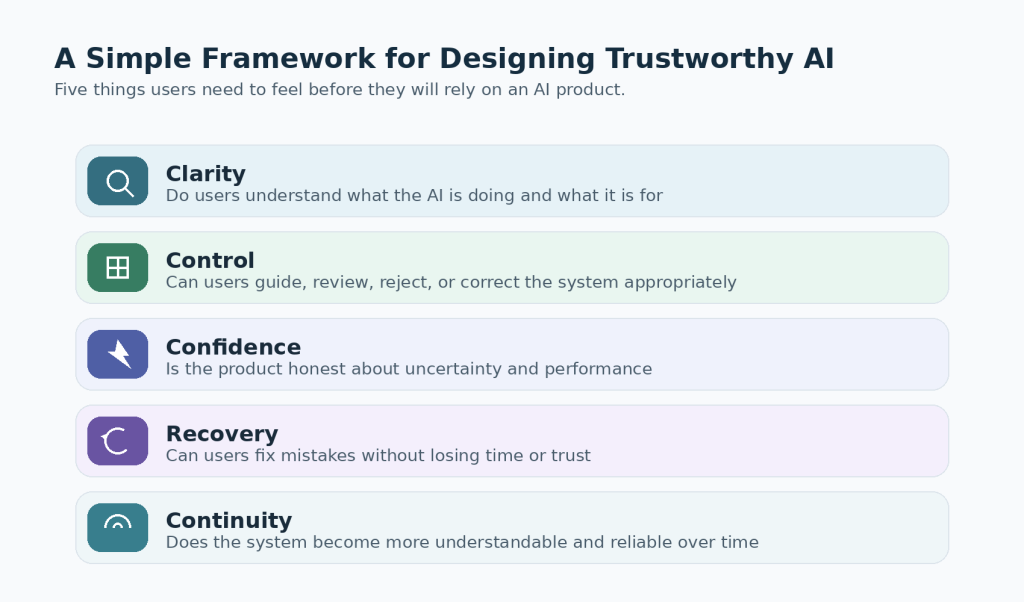
A Simple Framework for Designing Trustworthy AI
If you want a clean lens, use this:
Lens
What good looks like
Clarity
Do users understand what the AI is doing and what it is for?
Control
Can users guide, review, reject, or correct the system appropriately?
Confidence
Is the product honest about uncertainty and performance?
Recovery
Can users fix mistakes without losing time or trust?
Continuity
Does the system become more understandable and reliable over time?
If your product is weak in one or more of those, trust will usually suffer somewhere.
Not always dramatically. Sometimes quietly. Quiet trust erosion is still erosion.
Final Thought
A lot of AI products are trying very hard to look smart. That is not the same as being trustworthy.
Trustworthy AI is not about making the system sound magical, flawless, or more human than it is. It is about helping people understand what the product can do, what it cannot do, how to work with it, and how to stay in control when it matters.
That requires better product thinking, not just better model performance.
Because in the end, trust is not built by the demo. It is built in the lived experience of using the product. And users are very good at noticing the difference.
Want to Go Deeper on Trustworthy AI?
If this is the kind of product thinking you want to build into your work, check out Designing Trustworthy AI. It is built for PMs, product marketers, founders, and operators who want to design AI products that people can actually understand and trust.