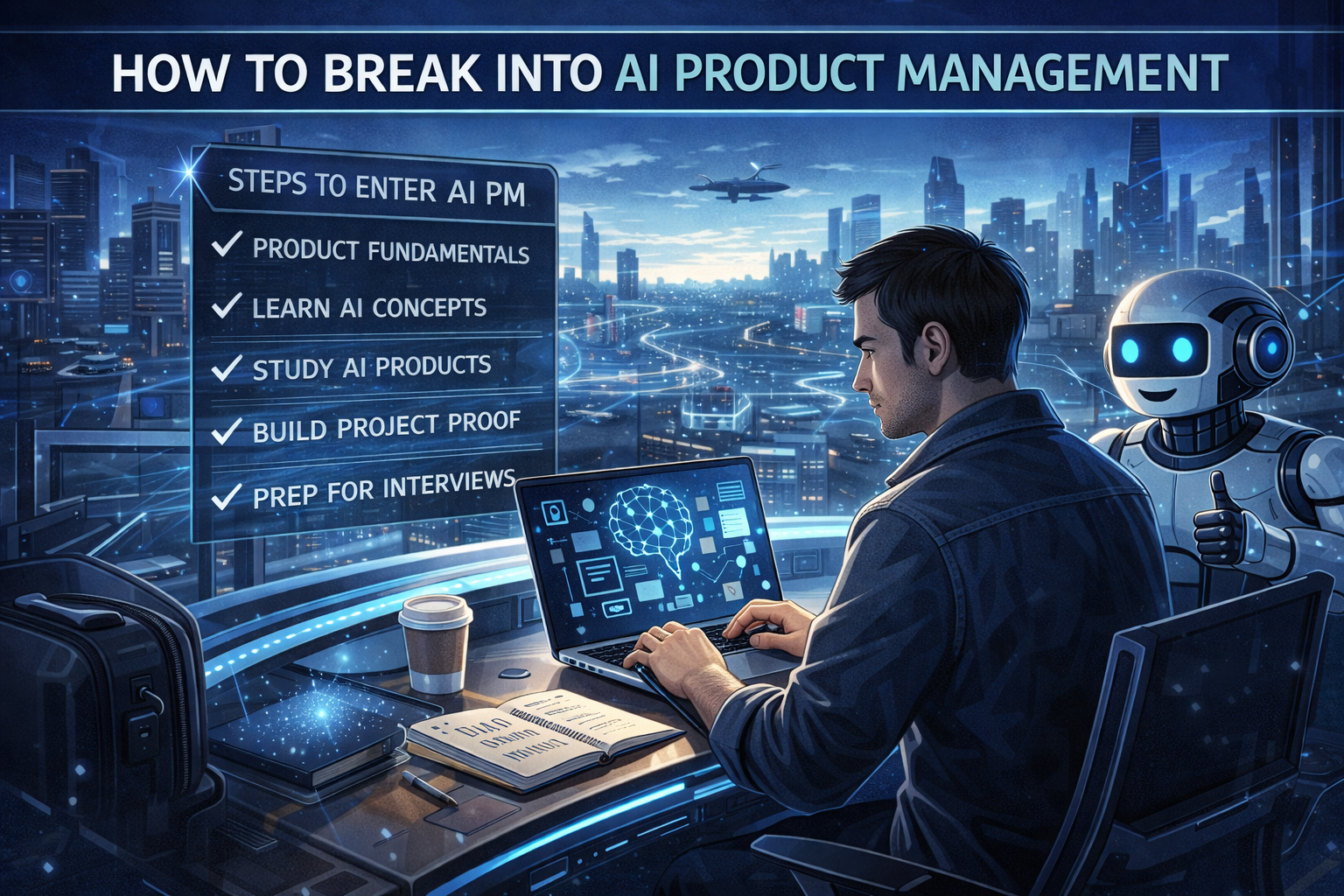
How to Break Into AI Product Management
A practical guide to building the right product skills, AI fluency, and proof that hiring teams can actually trust.
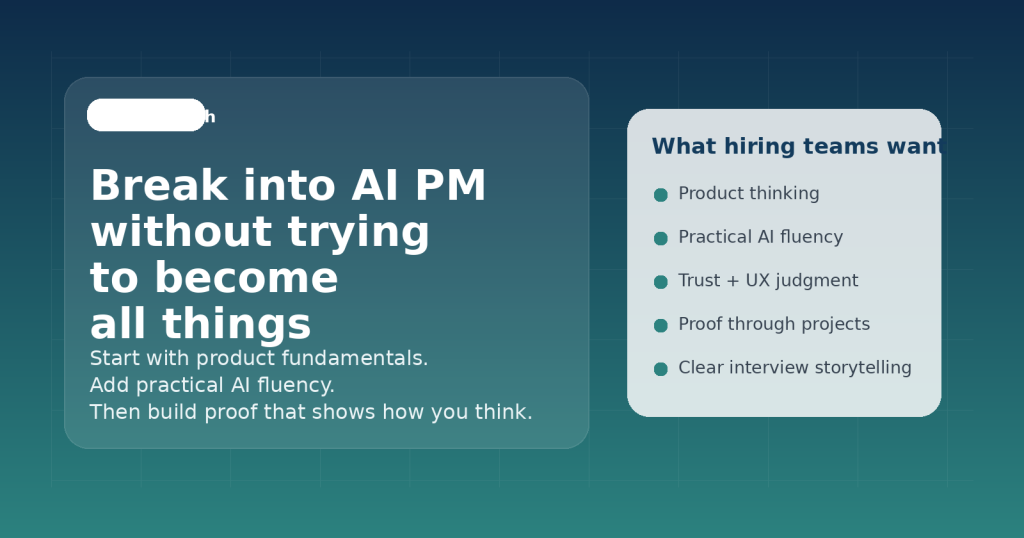
A cleaner framing for a crowded conversation: AI PM is still product management — just in a more probabilistic, trust-sensitive environment.
A lot of people want to break into AI product management right now. That makes sense. It sits close to where a lot of new product innovation is happening, and it gives you a chance to work on real problems that shape how people interact with AI in the real world.
It also feels confusing from the outside. Job descriptions, LinkedIn posts, and random advice online can make it sound like you need to be part strategist, part machine learning expert, part founder, and part prompt wizard before you are even allowed to apply.
You do not need to become everything at once. You do need to understand what the job actually is, build the right core skills, and learn how to position your background in a way that makes hiring teams trust that you can do the work.
“You do not need to become everything at once. You need product fundamentals, practical AI fluency, and proof that you can think clearly in this space.”
The short version
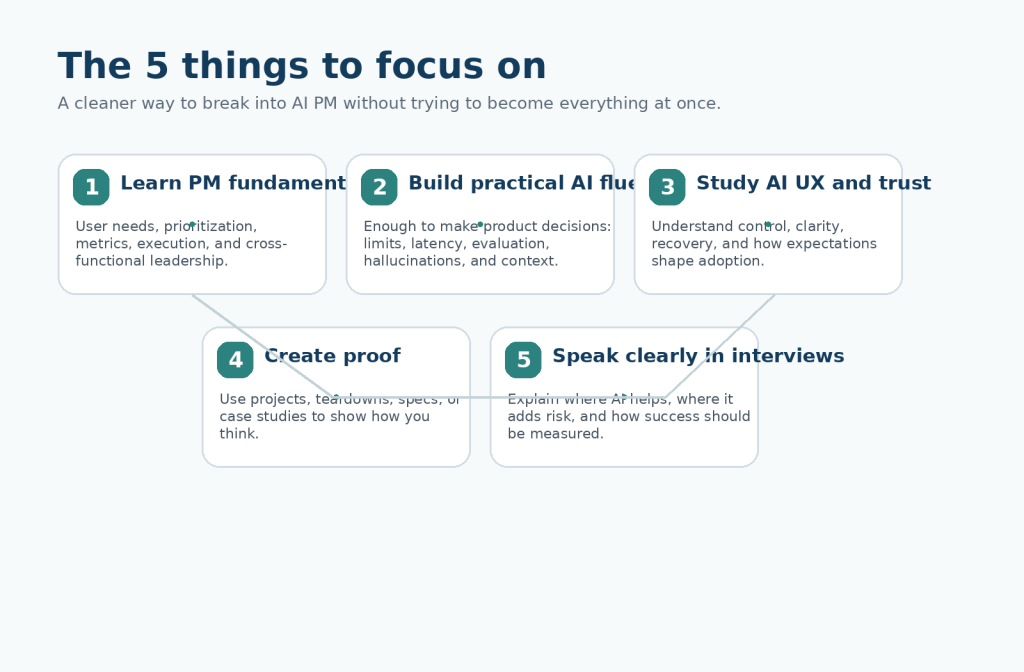
· Learn the fundamentals of product management.
· Build practical AI product fluency.
· Understand how AI changes UX, trust, and product decisions.
· Show evidence of product thinking through projects, case work, or relevant experience.
· Learn how to talk about AI products clearly in interviews.
First, know what you are actually trying to break into
AI product management is not just product management with more buzzwords. But it is also not a completely separate profession. At its core, the job is still about solving real user problems through product strategy, prioritization, cross-functional leadership, and iteration.
What changes is the system you are managing. AI products are often more probabilistic, less predictable, and more sensitive to trust, UX, and expectation setting than traditional software. That means AI PMs have to think more carefully about where AI actually adds value, how users should experience it, what happens when the system is wrong, and how success should be measured.
There are three common paths into AI PM
Path
What it usually means
PMs moving into AI
You already have product fundamentals. The job is to add AI product fluency on top of that base: trust, UX, evaluation, and technical tradeoffs.
Technical people moving toward product
You may already understand systems and models. The growth area is usually user needs, prioritization, communication, and product value.
Adjacent operators breaking in
People from product marketing, design, operations, analytics, consulting, or founder backgrounds can absolutely break in. The key is showing product judgment, not just enthusiasm.
What hiring teams actually look for
1. Product thinking
Can you identify a real user problem, frame a useful solution, and make smart tradeoffs?
2. AI fluency
Do you understand enough about AI systems to make thoughtful product decisions without pretending to be an ML engineer?
3. Communication
Can you explain complex ideas clearly and translate system behavior into user impact?
4. Trust and judgment
Do you take reliability, transparency, control, privacy, and user expectations seriously?
5. Evidence
Have you created projects, case studies, writing, or adjacent experiences that show how you think?
Step 1: Build the right foundation in product management
Before you specialize in AI product management, make sure you understand product management itself. That means learning how to identify user needs, define product problems clearly, prioritize features and tradeoffs, think about metrics and outcomes, work cross-functionally, and ship, learn, and iterate.
AI PM is not a shortcut around product fundamentals. If you skip the basics, the AI layer will not save you. It will just make your confusion sound more modern.
Step 2: Learn enough AI to make product decisions
You do not need a PhD, and you do not need to become a machine learning engineer. You do need enough practical understanding to be credible and useful.
- What large language models are good at.
- Why AI outputs can be inconsistent.
- What hallucinations are and why they matter.
- What latency is and how it affects user experience.
- How context improves or limits performance.
- The difference between a good demo and a good product.
- Why evaluation is hard in AI systems.
- How AI changes trust and UX decisions.
Step 3: Study AI products like a product manager
One of the fastest ways to grow is to stop using AI products only as a user and start analyzing them like a PM. Ask what problem the product is solving, why AI is the right approach, where the experience feels helpful, where it feels awkward, how it builds trust, what happens when it is wrong, and what you would improve.
Anyone can say they are passionate about AI. Far fewer people can explain why one AI product experience feels strong and another feels flimsy. That difference shows up in interviews.
Step 4: Build proof through projects
This is the step many people skip. Reading helps, but it is not enough on its own. You need proof that you can think like an AI PM.
- A case study you wrote.
- A teardown of an AI product.
- A product spec for an AI feature.
- A portfolio project or mock roadmap.
- A user problem analysis.
- A blog post with clear product thinking.
- A side project where you define the problem, UX, trust considerations, and success metrics.
Step 5: Learn to talk about AI clearly
A lot of candidates lose credibility in AI interviews because they either sound too vague or too technical in the wrong way. Strong candidates explain AI products in plain English. They talk clearly about the user problem, where AI adds value, where it adds risk, and what tradeoffs the team should make.
Avoid this
Do this instead
“Leverage AI to unlock transformative intelligence-driven workflows.”
“Use AI to shorten a repetitive task, then let the user review and edit before anything is sent.”
Step 6: Position your existing background the right way
You do not need your past experience to look exactly like an AI PM role. You need to frame it in a way that highlights relevant strengths and makes your path make sense.
If you are already a PM, emphasize:
- Product strategy
- Customer discovery
- Execution
- Prioritization
- Launches, metrics, and iteration
If you come from a technical role, emphasize:
- Systems understanding
- Model awareness
- Analytical rigor
- Technical collaboration
- Then show stronger product instincts and communication
If you come from product marketing, design, operations, or consulting, emphasize:
- Customer insight
- Problem framing
- Clear communication
- Workflow understanding
- Cross-functional influence, then show you can make product decisions
Step 7: Prepare for AI PM interviews specifically
AI PM interviews still test product sense, prioritization, metrics, and execution. But they often add questions about AI feature design, evaluation, hallucinations, weak outputs, trust, and control.
The strongest answers usually have the same shape: a clear user problem, why AI is or is not appropriate, how the experience should work, what could go wrong, and how success would be measured.
The biggest mistakes people make when trying to break in
Watch for these traps
· Trying to sound smarter than you are instead of being clear.
· Over-focusing on tools instead of product judgment.
· Ignoring trust and user experience.
· Waiting until you feel fully ready.
· Treating AI PM like a totally different identity instead of an adaptation of your existing strengths.
A simple 60-day plan to start breaking in
A practical path beats endlessly chasing whatever model launched yesterday.
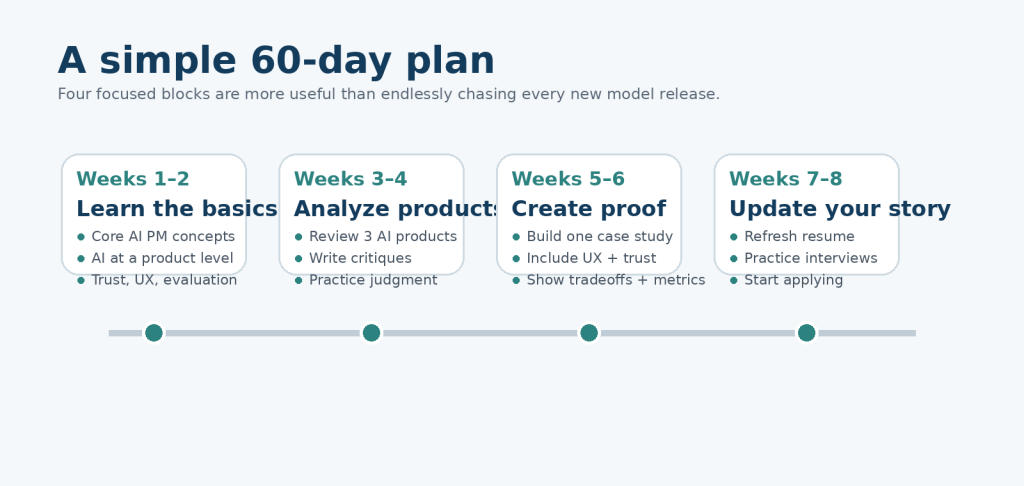
- Weeks 1 and 2: learn the basics of AI product management and core AI concepts at a product level.
- Weeks 3 and 4: analyze three AI products in depth and write short critiques or teardowns.
- Weeks 5 and 6: create one portfolio piece or case study that includes UX, trust, metrics, and tradeoffs.
- Weeks 7 and 8: update your resume and LinkedIn for AI relevance, practice interview questions, and start applying or networking with a clearer story.
Final thought
Breaking into AI product management is very possible. But it usually does not happen by accident.
The strongest candidates combine three things: a real product foundation, practical AI fluency, and clear evidence that they can think about AI products in a useful, trustworthy, grounded way.
That is what hiring teams want. Not perfection. Not hype. They want someone who can help build products that make AI actually useful for people.
Want to go deeper?