

How to Evaluate an AI Product Idea Before You Build It
How to Evaluate an AI Product Idea Before You Build It
A practical framework for separating useful AI product bets from demo bait.
A lot of weak AI products follow the same pattern: a new model demo sparks excitement, ideas start flying, and teams rush into building before anyone has really asked whether the idea is worth shipping. This article turns that instinct into a better discipline.
“Good AI product managers slow down just enough to ask a better question: Is this actually worth building?”
The short version
A strong AI product idea is not defined by how advanced it sounds. It is defined by whether it:
• Solves a real user problem
• Uses AI for the right reason
• Creates a clear product experience
• Handles failure and uncertainty well
• Delivers measurable value
Why this matters more in AI
Bad product ideas exist in every category, but AI raises the cost of getting it wrong. It adds more complexity, more failure modes, more operating cost, more trust risk, and more ambiguity in the user experience. That means weak ideas rarely fail quietly. They create confusion, frustration, and sometimes real trust damage.
• More complexity
• More failure modes
• More cost to run
• More trust risk
• More UX ambiguity
That is why evaluation matters more, not less.
Step 1: Start with the human problem
This sounds obvious. It is also where many AI ideas fail.
A lot of teams start with, “We have AI. What can we do with it?” That is backwards.
Start with the user instead. What are they trying to do? Where are they stuck? What feels slow, repetitive, confusing, or manual? What outcome actually matters to them?
Then ask the harder question: would AI meaningfully improve that moment?
One of the clearest lessons here is simple: you are not building intelligence for its own sake. You are building relief — relief from friction, effort, and complexity. If the idea does not create that, it is probably noise.
Questions to ask
• What is the user trying to do?
• Where are they struggling?
• What is slow, repetitive, confusing, or manual?
• What outcome matters most to them?
Step 2: Ask why AI is the right approach
Not every problem needs AI. Some problems are better solved with clearer UX, stronger defaults, better workflow design, or ordinary product logic.
AI should earn its place. It is powerful, but it is not neutral. It introduces tradeoffs.
Good reasons to use AI
Bad reasons to use AI
• The problem involves language, interpretation, or ambiguity.
• The task requires flexibility, generation, or prediction.
• Personalization would create meaningful user value.
• Rules alone cannot solve the problem cleanly.
• It sounds impressive.
• Competitors are doing it.
• Leadership asked for “something AI.”
• It demos well.
Step 3: Define the product experience, not just the capability
Many AI ideas sound good because teams describe what the model can do, not how the product will feel.
That is how you get features that technically work but still feel confusing or fragile.
Do not stop at “the model generates a response.” Define the user moment. What do they see first? Is the AI suggesting, assisting, or deciding? What happens when it is wrong? How do they correct it? How much control do they have?
Capability is not the product. The user experience is the product.
Questions to ask
• Where does the AI show up in the workflow?
• Is it suggesting, assisting, or deciding?
• What does the user see first?
• What happens when the AI is wrong?
• How does the user correct it?
• How much control do they have?
Step 4: Design for failure early
Every AI system fails. The question is not whether failure happens, but how it shows up and how recoverable it is.
Weak ideas assume success. Strong ideas plan for failure.
Think through the likely failure modes, how damaging they are, how often they might happen, and what the product should do in response.
Design clear fallback behavior, easy correction paths, honest messaging, and graceful recovery. A product that occasionally delights but frequently confuses will not last.
Trust before delight.
Step 5: Define what success actually means
A common mistake in AI work is vague success criteria. “We want users to use it” is not enough.
Start with value for the user. Did the feature save time? Improve quality? Reduce effort? Increase confidence?
Then define signals that tell you whether that value is real.
Acceptance rate
Edit rate
Retry rate
Task completion
User satisfaction
Repeat usage
In AI, usage without value is common. You need to know the difference.
Step 6: Evaluate the trust cost
Every AI feature has a trust cost. Some are small. Some are large. The higher that cost, the stronger your product design needs to be.
If users could be misled, overconfident, exposed, or left without control, you need better expectations, better feedback, and more recoverability.
Questions to ask
• How visible is the AI behavior?
• How confident does it sound?
• How often could it be wrong?
• How sensitive is the use case?
• How much user control exists?
• How easy is it to recover?
Step 7: Pressure test the idea before you commit
Before engineering time and organizational energy get locked in, pressure test the idea.
If you cannot explain the value clearly, describe where the system works and struggles, justify why AI is necessary, and name how success will be measured, the idea needs more work.
This is not about perfection. It is about clarity.
Pressure test checklist
☐ Can you explain it clearly in one sentence?
☐ Can a user understand what it does quickly?
☐ Can you describe when it works well and when it struggles?
☐ Can you explain why AI is necessary?
☐ Can you define how you will measure success?
A simple framework you can reuse
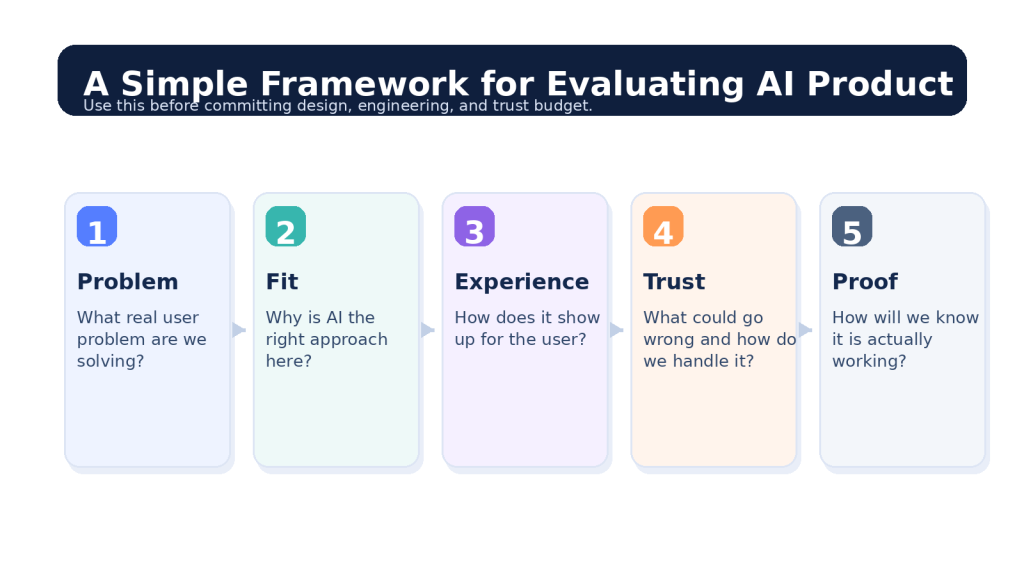
When you want a fast gut-check, use this five-part lens:
What strong AI PMs do differently
• They do not chase ideas. They shape them.
• They slow down early so they do not waste time later.
• They ask better questions.
• They think about trust before launch, not after.
• They design the experience, not just the feature.
• They measure real value, not just interaction.
• They are comfortable saying, “This is not worth building yet.”
Final thought
AI makes it easier than ever to build something that looks impressive. It does not make it easier to build something people actually want to use. That still requires product judgment, clarity, and the discipline to ask harder questions before you start building.
Keep this lens in front of you: Problem. Fit. Experience. Trust. Proof.
If you want a more structured way to think through problems like this, check out AI Product Management Fundamentals.