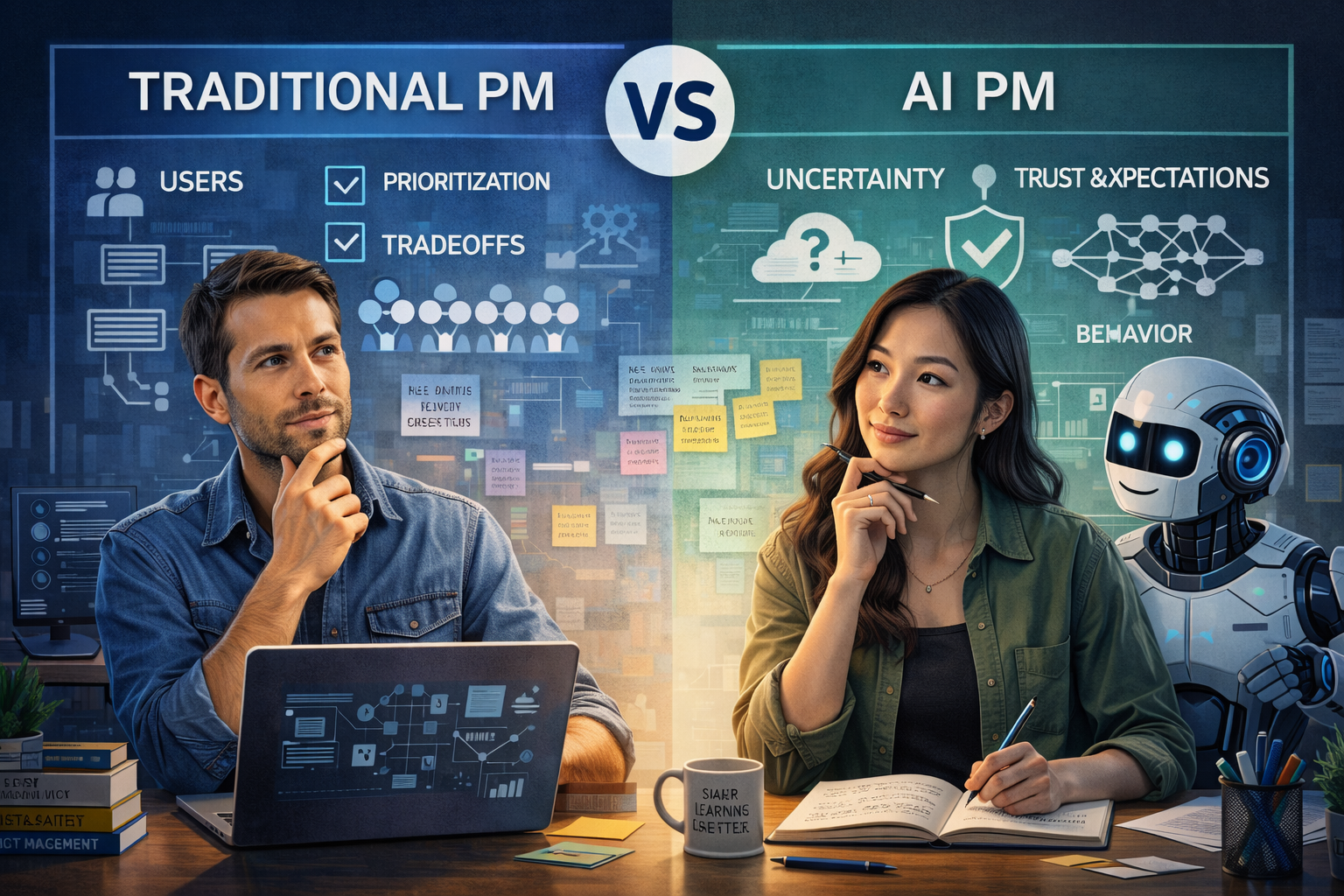
Traditional PM vs. AI PM: What Changes and What Doesn’t
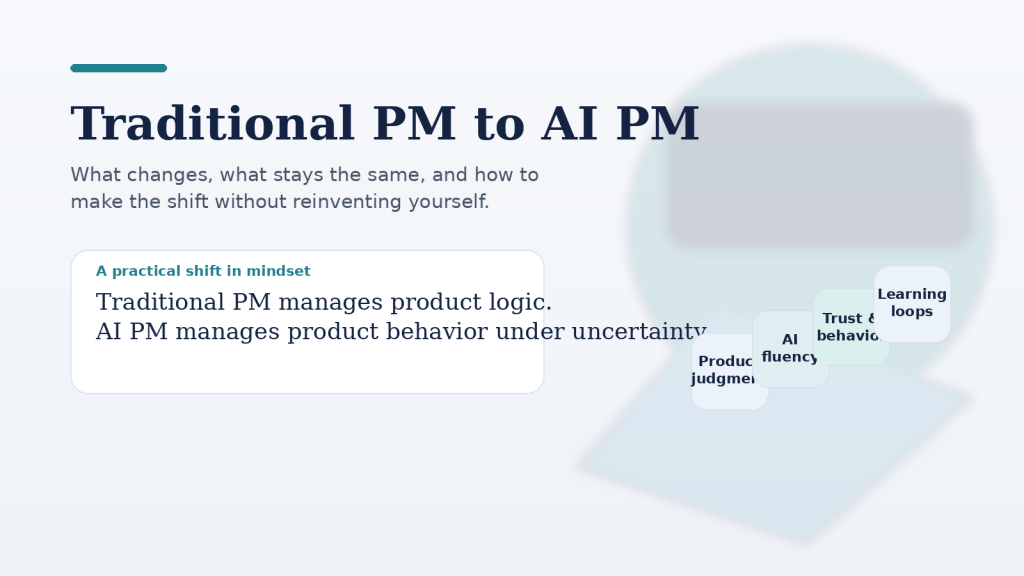
Traditional PM to AI PM
What changes, what stays the same, and how to make the shift without reinventing yourself.
If you are already a product manager and trying to move into AI, you have probably had some version of this thought: Do I need to completely reinvent myself to become an AI PM?
The honest answer is no. But you do need to evolve.
This is where a lot of people get stuck. They assume AI product management is either just regular product management with a trendy label or a totally different job that requires becoming a machine learning expert overnight. Neither is true.
AI product management still relies on the same core product skills that great PMs have always needed. You still need to understand users, define good problems, align teams, make tradeoffs, prioritize clearly, and ship things that create value.
What changes is the shape of the system you are managing. Traditional software is usually more predictable. AI products are often more probabilistic, more ambiguous, and more sensitive to trust, UX, and expectation setting.
That means some of your PM muscles stay the same. Some need to get stronger. And a few entirely new ones matter much more than they used to.
The short version
Traditional PM manages product logic. AI PM often manages product behavior under uncertainty.
You are still doing product management. But now you are deciding how much the user should trust the system, how much control they should keep, and what the experience should feel like when the system is helpful, uncertain, or wrong.
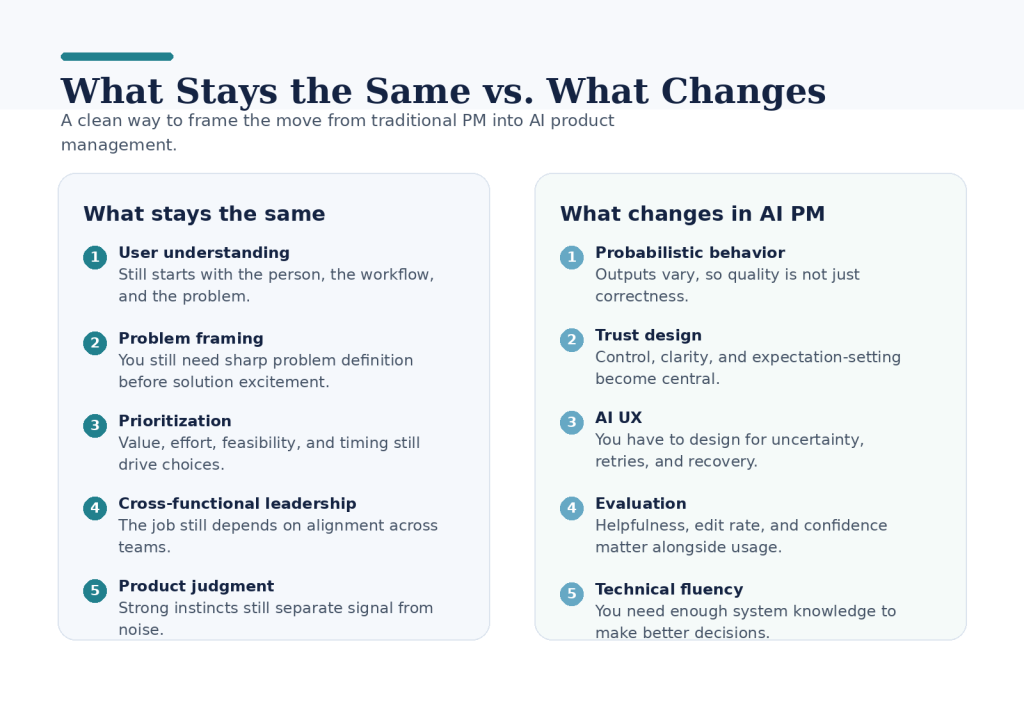
What stays the same
Let’s start with the good news. If you are a solid PM already, you are not starting from zero. A lot of the job still looks familiar.
1. User understanding still comes first
This part does not change at all. You still need to know:
- Who the user is
- What they are trying to do
- Where they are struggling
- What outcome matters to them
- Why the current workflow is broken or frustrating
AI does not remove the need for customer understanding. If anything, it makes it more important.
Because once teams get excited about the technology, they become even more likely to build something clever that nobody needed.
The best AI PMs are still deeply grounded in user reality.
2. Problem definition still matters more than solution excitement
Great PMs know that a poorly defined problem leads to weak product decisions. That is just as true in AI.
Actually, it is even more true in AI because the temptation to jump straight to the shiny solution is stronger.
A lot of bad AI products start with some version of this: “We have access to a model. What can we add?”
Strong AI product work starts with a better question: “What real problem is worth solving, and where would AI genuinely improve the experience?”
That is still classic PM thinking.
3. Prioritization is still core to the job
You are still balancing value, effort, feasibility, and timing. You are still deciding what matters now versus later.
You are still dealing with resource constraints, stakeholder opinions, and the painful truth that everything cannot be top priority at the same time.
The difference is that in AI product work, you may also need to factor in things like:
- Model quality
- Latency
- Cost to serve
- Evaluation complexity
- Trust risk
- Failure severity
But the prioritization muscle itself is still the same one.
4. Cross-functional leadership still matters
AI PM is not a solo sport.
You still need to align engineering, design, research, data, leadership, and often legal or policy partners too.
You still need to communicate clearly, create direction, reduce ambiguity, and help the team make decisions together.
This is one reason experienced PMs can transition into AI more effectively than they think. The cross-functional core of the work does not go away. If anything, it gets more important.
5. Product judgment is still your biggest asset
At the end of the day, the best PMs are not just organized people with clean documents. They have judgment.
They know how to spot weak ideas, ask better questions, and separate real value from internal excitement.
That is still one of the most important parts of the job in AI. Actually, it may be even more valuable, because AI creates more room for noise, novelty, and false confidence.
What changes in AI product management
Now let’s talk about the shift. This is where AI PM starts to feel meaningfully different from traditional PM.
1. You are working with probabilistic systems, not just deterministic ones
This is probably the biggest technical and product difference.
Traditional software often behaves in fixed ways. If the conditions are met, the product performs the expected action. AI systems often do not behave that way.
They generate outputs with varying levels of quality. They interpret intent. They make predictions. They classify. They summarize. They recommend. They sometimes surprise you, and not always in a charming way.
That means the product experience is less about whether the feature works at all and more about how well it works, how often, under what conditions, and whether the user still trusts it when it falls short.
This changes how you think about product quality. In traditional PM, quality often means correctness and stability. In AI PM, quality also includes helpfulness, consistency, confidence, clarity, and recovery.
2. Trust becomes a much more central product concern
Trust matters in all products. But in AI products, trust is often one of the core things you are managing.
Users need to know:
- What the system is doing
- What it can and cannot do
- How much they should rely on it
- What happens when it gets something wrong
- Whether their data is being used responsibly
- Whether they are still in control
In traditional PM, trust is often important but somewhat backgrounded unless the product is high stakes.
In AI PM, trust is frequently front and center even in everyday workflows. This is because the system can sound confident, behave unexpectedly, or make people feel like they do not fully understand what is happening.
That changes the UX and the product strategy.
3. UX design has to account for uncertainty
A lot of traditional product design assumes the system should produce a clear, expected result. AI UX is trickier.
Now you have to think about:
- How the product behaves when the answer is imperfect
- Whether the user should see confidence cues
- How much explanation is helpful
- When the system should ask for confirmation
- How to handle retries, corrections, and fallback flows
- Whether the AI should suggest, assist, or decide
This is why strong AI product work often feels less like feature shipping and more like behavior design.
You are shaping a relationship between the user and a system that is capable but imperfect.
4. Evaluation gets harder
In traditional PM, success metrics can be more straightforward:
- Did the user complete the flow
- Did conversion improve
- Did retention go up
- Did the feature reduce time to task completion
Those still matter in AI products. But now you may also need to ask:
- Was the output actually useful
- Was it accurate enough
- Did users accept it or edit it heavily
- Did they retry because the first result was weak
- Were the responses consistent
- Did quality degrade in certain contexts
- Did users trust the experience more or less over time
This makes evaluation more layered.
You need quantitative metrics, qualitative feedback, behavioral signal, and often closer collaboration with technical teams to interpret what is happening.
5. Launch is less about shipping and more about learning
All good PMs know product work continues after launch. In AI, that becomes even more obvious.
AI products often need post-launch refinement because real-world use reveals edge cases, behavior issues, trust gaps, confusing outputs, and surprising usage patterns that internal testing did not fully capture.
So the AI PM mindset needs to be more iterative. You are not just shipping a feature. You are launching a system that will teach you how it behaves in the hands of real users.
That means your post-launch learning loop matters a lot more.
6. Technical fluency becomes more important
You do not need to become an ML engineer. But the bar for technical fluency is usually higher in AI PM.
You need to understand enough to ask useful questions about:
- Model capabilities and limitations
- Latency
- Context windows
- Grounding and retrieval
- Failure modes
- Evaluation methods
- Prompt or orchestration behavior
- Cost tradeoffs
- Data dependencies
This is not about showing off in technical meetings.
It is about making better product decisions.
The more AI is core to the experience, the more important this becomes.
What new skills matter more in AI PM
Some skills matter in both traditional PM and AI PM. But in AI, a few become especially important.
Comfort with ambiguity
AI systems do not always behave in neat, predictable ways. If you need everything to be perfectly defined before you can make progress, this field will feel painful. Strong AI PMs can work through uncertainty without becoming vague or careless.
Better failure thinking
In traditional PM, failure states still matter. In AI PM, they become central. You need to think deeply about what happens when the product is wrong, incomplete, slow, awkward, or misleading. That is not edge-case thinking. That is core product thinking.
Clearer communication
AI products create more confusion, both inside teams and outside them. A strong AI PM can explain complex tradeoffs in plain English. They can align technical and nontechnical stakeholders without watering down the truth. That skill becomes a huge advantage.
Stronger trust instincts
AI product work rewards PMs who think carefully about user confidence, privacy, control, transparency, and expectation setting. This is not just policy language. It is product judgment.
Sharper experimentation habits
Because AI products are more variable, you often need to test and learn more deliberately. That includes prompt variations, UX patterns, quality thresholds, fallback behaviors, onboarding language, and trust cues. Experimentation becomes less of a growth tool and more of a product understanding tool.
Where traditional PMs usually struggle when moving into AI
This transition is very doable, but a few patterns show up often.
Over relying on deterministic thinking
Traditional PMs sometimes expect the product to behave more consistently than AI systems do. That can lead to unrealistic requirements or weak evaluation strategies.
Underestimating UX complexity
Some people assume the hard part is the model and the easy part is the product experience. Often the opposite is true. The intelligence might work reasonably well, but the product still fails because the user experience does not help people understand, trust, or recover from the system.
Confusing model quality with product quality
A technically strong model is not the same thing as a good product experience. Users do not grade you on architecture. They grade you on whether the product helps them.
Treating trust as a later concern
Teams get excited about usefulness first and assume trust can be layered in later through messaging or policy. Usually that ends badly. Trust needs to be built into product behavior from the beginning.
Thinking you need to know everything before starting
You do not. You need enough technical fluency to collaborate, enough product judgment to ask good questions, and enough curiosity to keep learning. That is a much more realistic bar.
How to transition from traditional PM to AI PM
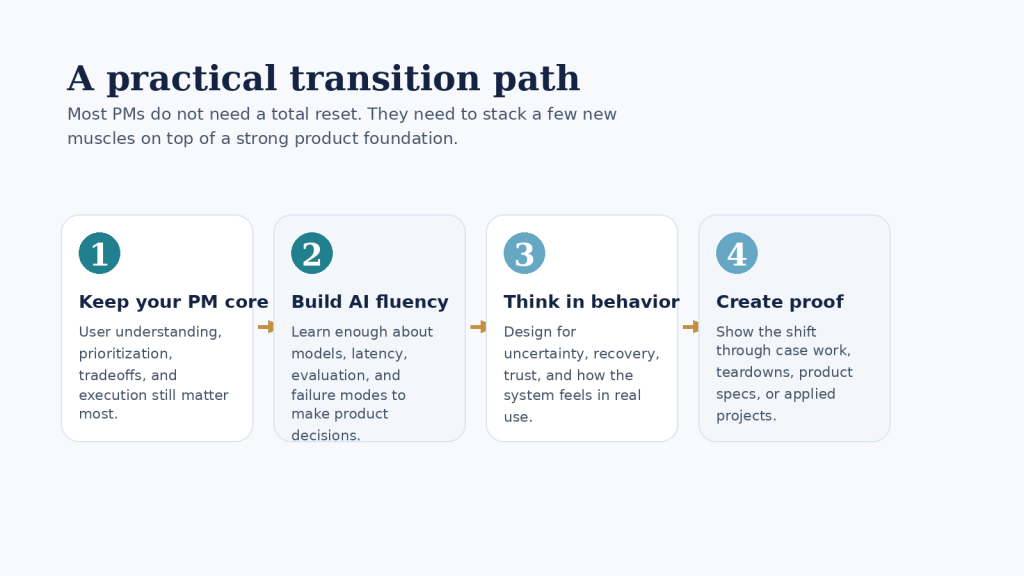
If you are a PM today and want to move into AI work, start by recognizing that many of your current skills still matter. Do not throw away your product foundation. Instead, build on top of it.
Focus on learning:
- How AI systems differ from traditional software
- What trust looks like in AI products
- How to think about failure states and user expectations
- How AI changes UX design
- How to evaluate product quality when outputs are variable
- How to talk about model tradeoffs in plain English
This is less about becoming a different kind of person and more about expanding your product lens.
You are still a PM. You are just learning to manage more uncertainty, more nuance, and more system behavior than before.
A simple way to frame the difference
If you want one clean mental model, use this:
A clean mental model
Traditional PM asks: What should the product do?
AI PM asks: What should the product do, how should it behave, and how should users experience that behavior when it is great, imperfect, or wrong?
That is the shift.
It is not a total reinvention.
But it is a meaningful evolution.
Final thought
Traditional PM and AI PM are not separate planets. They are related disciplines.
The best traditional PMs already have many of the instincts needed to succeed in AI. They know how to understand users, frame problems, prioritize well, and lead across functions.
What AI adds is more uncertainty, more behavioral complexity, more trust responsibility, and a greater need for technical fluency.
That is the challenge. It is also the opportunity.
Because as AI products keep spreading, the PMs who can combine classic product judgment with a deeper understanding of AI behavior will be the ones who build products people actually want to use. Not just try once. Use.
Want to build the skills that help PMs move into AI?
If you are making the shift from traditional product management into AI, AI Product Management Fundamentals is a natural next step.
The core value here is practical AI product judgment: trust, tradeoffs, UX, and the real differences between traditional product work and AI product work.